
Ensuring Valuation Accuracy: A Guide to Gold Testing Kits
Gold loans represent one of the safest and most liquid credit products for cooperative banks and microfinance institutions. However, the integrity of a gold loan portfolio relies entirely on one critical variable: the accuracy of the gold appraisal. Over-valuing an ornament due to fake gold, heavy solder, or core-filled pieces can lead to significant financial write-offs if the borrower defaults. Under-valuing, on the other hand, alienates customers and drives them to competitors.
To mitigate these risks, gold appraisers must have access to high-quality, standardized testing tools. This guide covers the essential components of a professional gold testing kit and best practices for accurate purity verification.
The Gold Appraiser's Essential Toolkit
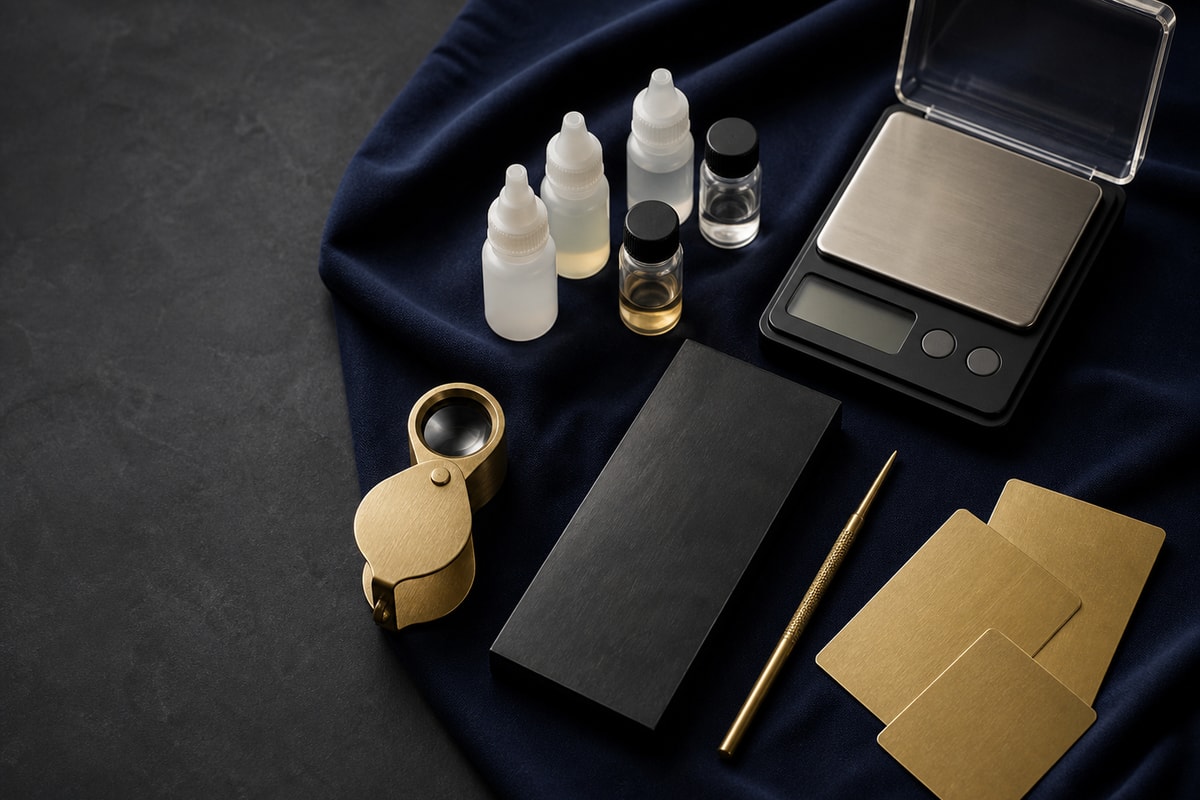
A professional gold testing kit is a combination of chemical, physical, and optical tools designed to verify the authenticity and karat value of gold ornaments without causing destructive damage. The core components include:
| Tool Name | Primary Function | Key Quality Metric |
|---|---|---|
| Touchstone (Kasoti) | A fine-grained, dark silica stone used to rub the gold ornament, leaving a metallic streak. | Must be natural, non-porous, and acid-resistant to ensure clean streaks and accurate reaction tests. |
| Testing Acids | Karat-specific test solutions compared with known-purity gold needles. For 24K gold, use an appropriate aqua-regia-based test solution, containing nitric acid and hydrochloric acid; nitric acid alone cannot verify 24K purity. | Use fresh, clearly labelled solutions and follow the supplier's instructions. Freshly mixed aqua regia must not be stored or sealed in an airtight container; trained staff must handle it under a suitable laboratory procedure. |
| Appraiser's Loupe | A magnifying glass (10x or 20x magnification) used to inspect hallmarks, joints, and solder marks. | Achromatic and aplanatic triplet lenses to eliminate color distortion and blurriness at the edges. |
| Specific Gravity Scale | A high-precision electronic scale with a water-immersion kit to measure density. | Use a calibrated scale with suitable precision for the sample. Density can help identify some lower-density substitutes, such as copper, but cannot reliably rule out tungsten: tungsten and pure 24K gold both have densities close to 19.3 g/cm³. |
| Testing Needles | Standardized gold needles of known karat values used to compare streaks on the touchstone. | Strictly verified purity ratings from certified refiners. |
Step-by-Step Purity Verification Protocol
To maintain risk control, every branch appraiser should follow a standardized testing process:
1. Visual Inspection
Use the loupe to inspect the ornament. Look for official government-recognized hallmarks, manufacturer marks, and discoloration near high-wear areas (which indicates plating). Pay close attention to joints and solder points; fraudulent ornaments often use thick base-metal cores covered by a thin layer of gold.
2. The Touchstone and Acid Test
- Gently rub a hidden portion of the ornament on the touchstone to create a clear, thick metallic streak.
- Use the test solution specified for the target karat and compare the streak with a known-purity testing needle. For 24K testing, use an appropriate aqua-regia-based solution containing nitric acid and hydrochloric acid, following the supplier's procedure.
- Observe the reaction:
- If the streak remains unchanged, the gold is at least of the tested karat purity.
- If the streak dissolves slightly or changes color, the purity is lower than the tested karat.
- If the streak disappears entirely, the ornament is fake or made of base metal.
- Estimate the karat by comparing the acid reactions with known-purity testing needles. A touchstone test checks a surface sample; it does not establish the purity of the whole item or rule out a concealed core.
3. Specific Gravity (Density) Measurement
Density measurement can provide an additional check for solid ornaments and may reveal some lower-density substitutes, such as copper. It cannot reliably distinguish tungsten from pure 24K gold because both have densities close to 19.3 g/cm³. A matching density does not prove that an item is genuine gold or exclude a hidden tungsten core. Use this method as one check, with further professional testing when needed:
- Weigh the ornament in the air and record the weight.
- Weigh the ornament fully submerged in water and record the weight.
- Calculate specific gravity:
Specific gravity = Weight in Air / (Weight in Air - Weight in Water). Multiply this value by the density of water at the test temperature to estimate the item's density. - Compare the result with an appropriate reference for the alloy being tested. Gold-alloy density varies with its composition; a difference calls for further testing rather than proving a particular core metal. Hollow sections, stones and trapped air can also affect the measurement.
Ensuring Calibration and Maintenance
Testing tools are subject to wear and chemical decay. To ensure absolute accuracy:
- Replace Acids Regularly: Testing acids degrade when exposed to air, light, and heat. Replace them every 3 to 6 months.
- Clean the Touchstone: After each test, clean the touchstone using fine emery paper or mild cleaning agents to remove residual metal streaks. A dirty touchstone will cause cross-contamination and false readings.
- Calibrate Scales Daily: Electronic specific gravity scales must be calibrated daily using standard calibration weights to prevent drift.
Conclusion
Standardizing the appraisal process with high-quality gold testing kits is a highly effective way for financial institutions to prevent loan defaults and operational losses. By training appraisers to utilize touchstones, fresh testing acids, and specific gravity scales in a structured workflow, cooperative lenders can confidently expand their gold loan portfolios while maintaining absolute risk control.